







As we move through 2026, the Boston rental market is experiencing its most policy-driven transformation in decades. Between Massachusetts’ broker fee reform and a proposed ballot initiative that could reintroduce local rent stabilization, both renters and landlords are adjusting to a new operational reality.
At ConnectAll Property Management, we actively manage properties across Greater Boston and advise owners daily on how these changes impact pricing strategy, tenant retention, and risk management. What follows is a data-informed breakdown of the current landscape—and what sophisticated property owners should be watching.
The End of Tenant-Paid Broker Fees (Effective August 1, 2025)
Massachusetts restructured broker fee responsibility beginning August 1, 2025.
Under the updated framework:
Landlord hires broker → landlord pays
Tenant hires broker and signs written agreement → tenant pays
No written agreement → no broker fee may be charged
Strategic Market Impact
This reform has:
Increased turnover costs for landlords
Incentivized lease renewals
Shifted pricing psychology from aggressive increases to retention optimization
In high-rent neighborhoods, absorbing a one-month broker fee plus vacancy loss can exceed $5,000–$8,000 per turnover.
Five Forces Reshaping Boston Rentals in 2026
1. Broker Fee Policy Impact (Active Since 2025)
Landlords now absorb one month’s rent in leasing fees.
Result: Renewals are financially preferable to aggressive rent hikes that risk vacancy.
2. Declining Student Population
Restrictive visa policies and shifting enrollment trends have softened growth in international student numbers.
Result: Student-heavy submarkets are seeing reduced demand volatility.
3. Economic Headwinds
Layoffs across technology, biotech, and related industries have tightened renter budgets.
Result: Rent affordability ceilings are becoming more binding in Class A and luxury segments.
4. Remote Work Exodus
Hybrid work remains entrenched.
Result: Renters are redistributing toward suburbs and secondary markets where price-per-square-foot is lower.
5. Landlord Behavior Shift
To avoid broker fees and vacancy costs, many landlords are holding rents steady.
Result: Less turnover = fewer active listings = lower visible inventory.
The 2026 Ballot Question: Rent Stabilization Debate
Rent control has been prohibited statewide since 1994 under:
Massachusetts General Laws Chapter 40P
https://malegislature.gov/Laws/GeneralLaws/PartI/TitleVII/Chapter40P
A 2026 ballot initiative would allow municipalities to adopt local rent stabilization measures.
Election updates can be monitored at:
Massachusetts Secretary of the Commonwealth – Elections Division
https://www.sec.state.ma.us/divisions/elections/
If approved, potential policy mechanisms could include:
Annual rent caps tied to CPI
Base rent benchmarks (January 2026 discussed)
Expanded just-cause eviction protections
The final structure would depend on enabling legislation and municipal implementation.
FAQs: Boston Rental Market 2026
1. Can landlords raise rent mid-lease under Massachusetts law?
No. Rent cannot be increased during a fixed-term lease unless explicitly allowed in the written agreement. Rent adjustments typically occur at renewal.
2. If rent stabilization passes, will it apply to all properties?
Historically, rent control programs exempt:
Owner-occupied small multifamily properties
Newly constructed buildings
Certain affordable housing units
The exact exemptions would depend on final legislation.
3. Are landlords allowed to increase rent to offset broker fees?
Yes, at renewal—provided proper notice is given and no rent stabilization caps apply. Market competition ultimately limits how much can be passed through.
4. How does broker fee reform affect investment returns?
Turnover cost modeling is now critical. Owners must factor:
Broker fee absorption
Average vacancy duration
Leasing marketing expenses
Potential rent growth
Retention strategy now directly impacts NOI (Net Operating Income).
5. Can landlords still charge application or credit check fees?
Only licensed real estate brokers may charge certain screening fees. Standard landlords cannot charge application or “hold” fees.
Legal framework:
Massachusetts General Laws Chapter 186, Section 15B
https://malegislature.gov/Laws/GeneralLaws/PartII/TitleI/Chapter186/Section15B
6. What are legally allowed move-in costs in Massachusetts?
Landlords may collect only:
First month’s rent
Last month’s rent
Security deposit (max one month)
Lock installation fee
Anything beyond this may violate state law.
7. Will rent stabilization reduce housing supply?
Economic research on rent control shows mixed outcomes. In some markets, strict caps have led to:
Condo conversions
Reduced new construction
Lower rental turnover
Policy design matters significantly.
8. How should landlords adapt in 2026?
Advanced strategies include:
Renewal-first leasing models
Preventative maintenance to reduce turnover
Competitive—but sustainable—rent pricing
Strict compliance management
Cash flow stress-testing under cap scenarios
9. Are tenants still entitled to safe housing regardless of policy changes?
Yes. Under the Massachusetts State Sanitary Code (105 CMR 410):
https://www.mass.gov/regulations/105-CMR-41000-minimum-standards-of-fitness-for-human-habitation-state-sanitary-code-chapter-ii
Landlords must provide:
Heat and hot water
Functioning smoke detectors
Structural safety
Pest-free conditions
10. Where can tenants seek assistance?
Boston Office of Housing Stability
617-635-4200
https://www.boston.gov/departments/housing/office-housing-stability
Common Advanced Concerns From Boston Property Owners
“Should I sell before rent stabilization passes?”
This depends on:
Property type
Debt structure
Equity position
Long-term investment horizon
Policy speculation alone should not drive liquidation decisions.
“Should I convert to condo?”
Conversion decisions must consider:
Market demand
Legal requirements
Tenant protections
Tax implications
Debt structure
Equity position
Long-term investment horizon
Policy speculation alone should not drive liquidation decisions.
“How do I reduce vacancy risk under the new broker fee rules?”
Retention strategy, faster maintenance response times, and professional tenant screening are now central to profitability.
Why ConnectAll?
"Because We Put Our Money Where Our Mouth Is."
Most property management companies make promises. We make GUARANTEES—backed by our wallet.
At ConnectAll Property Management, we operate in today’s policy-driven market with confidence because our systems are built for compliance, retention optimization, and risk mitigation.
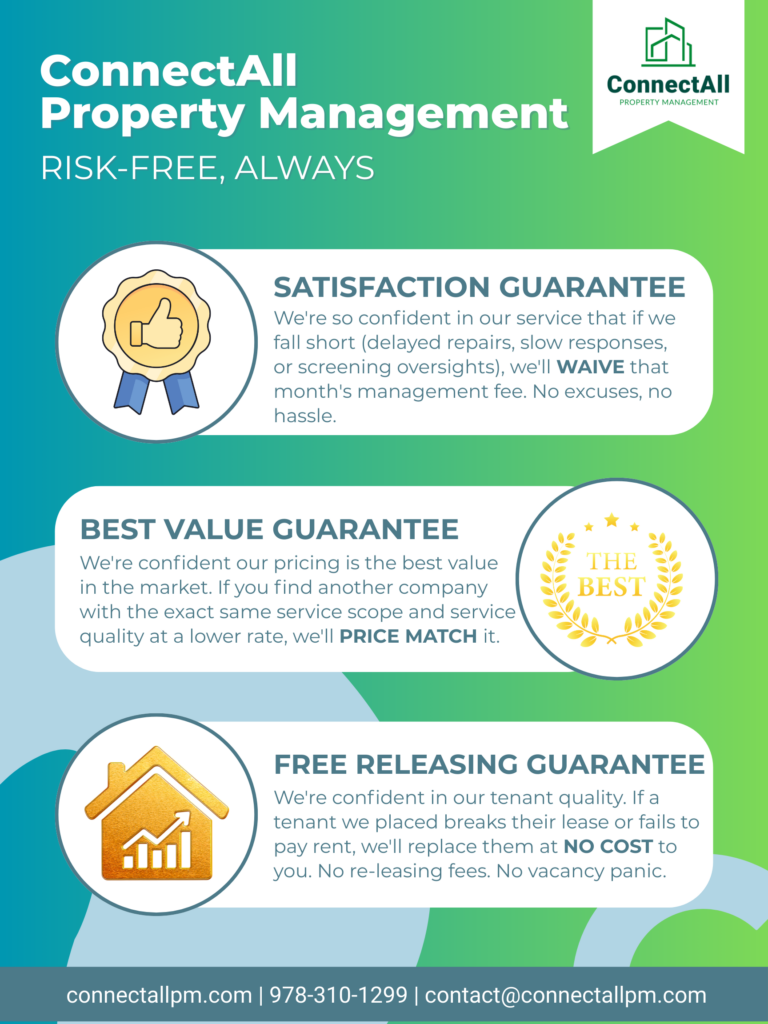
Our Three Guarantees:
BEST VALUE GUARANTEE
Find another company with the same service quality and scope at a lower price? We’ll match it.
SATISFACTION GUARANTEE
We fall short (delayed repairs, slow responses, screening oversights)? We waive that month’s management fee. No excuses.
FREE RE-LEASING GUARANTEE
Tenant we placed breaks lease or doesn’t pay? We find your replacement at NO COST. (Saves you $2,000–3,000)
RISK-FREE, ALWAYS.
Because we’re confident enough in our service to guarantee it.
Ready to experience property management without the worry?
Text: 978-310-1299